#^SpaceX to deliver 119 payloads to Sun-synchronous orbit on Transporter 16
SpaceX is set to launch 119 payloads to Sun-synchronous orbit from California for the Transporter 16 mission. Being launched as part of SpaceX’s SmallSat Rideshare Program, Transporter 16 and all prior Transporter missions have provided satellite operators with reliable access to space at a cost cheaper than that for a dedicated launch.
Launch is scheduled within a 57-minute launch window that opens at 3:20 AM PDT (10:20 UTC) on Monday, March 30. Falcon 9 will liftoff from Space Launch Complex 4 East (SLC-4E) at the Vandenberg Space Force Base in California.
Falcon 9 will follow a southern trajectory out of Vandenberg. SpaceX’s droneship,
Of Course I Still Love You, will be stationed downrange in the Pacific to recover the first stage booster, B1093. Flying its 12th mission, B1093 previously supporting nine Starlink and two Tranche 1 Transport Layer missions.
Once the upper stage reaches the targeted Sun-synchronous orbit (SSO), it will complete four engine burns. Payload deployments will begin at T+55 minutes and finish at T+2:31 hours. Transporter-16’s payloads include picosatellites, nanosatellites, and an orbital service vehicle (OSV). German-based Exolaunch is the largest customer, manifesting 57 payloads.
ExolaunchExolaunch has launched payloads on every SpaceX rideshare mission since the program’s inception in 2020, deploying more than 670 satellites into orbit. On Transporter-16, Exolaunch is providing launch access to over 25 companies, government agencies, and academic institutions. It is hosting 26 microsats and 31 cubesats on the mission.
Aethero Space’s Phobos (Credit:Exolaunch) Femto-1, developed by EnduroSat, is a demonstration of a high-efficiency electric propulsion system. Once in orbit, the spacecraft will perform a series of maneuvers to test the thruster’s performance, behaviors, and efficiency. Another customer, Aethero Space, is manifesting Phobos. The payload is a 4U microsatellite that serves as a demonstration for on-orbit data centers and features an Nvidia computing module, offering 20 times the current on-orbit compute. Phobos will demonstrate AI/computing in space, and it will image Earth and its local space environment before a safe deorbit.
Exolaunch is also hosting the 6U Compact Spaceborne Magnetic Observatory (COSMO) satellite from the University of Colorado, Boulder, and the Laboratory for Atmospheric and Space Physics. COSMO will take measurements of Earth’s magnetic field with a magnetometer and then create a more accurate global model of Earth’s magnetic field.

The COSMO Observatory (Credit:Exolaunch)
Greece’s Ermis 1, 2, and 3, along with PeakSat, will represent Greek space technology demonstrations. Ermis-1 and Ermis-2 are 6U Earth-observation satellites. The constellation also includes Ermis
–3, an 8U satellite, featuring space-based 5G and Internet of Things (IoT) connectivity. PeakSat, developed entirely by students at the Aristotle University of Thessaloniki, is a 3U nanosatellite specializing in optical communications using laser links.
Disco-2 is a student-developed 3U CubeSat from Aarhus University in collaboration with the IT University of Copenhagen and the University of Southern Denmark. The satellite will monitor the effects of climate change in the Arctic and northeast Greenland. Using optical and thermal cameras, it will image glaciers and measure sea temperatures to study the link between warming waters and accelerated ice melt. Another ocean health satellite, TORO3, developed by Pyras Technology Inc builds on the existing satellites TORO and TORO2. These ocean-color sensing satellites monitor algae concentrations, plankton blooms, and other related marine ecosystems.

Exolaunch staff with PeakSat (Credit:Exolaunch)
SEOPSBeyond Exolaunch, another large contributor to Transporter-16 is SEOPS. The company is manifesting 19 payloads with a variety of government, commercial, and academic purposes. In total, 13 countries are represented across SEOPS’s payloads.
Among them is Alba Orbital, based in Scotland. The company has slots for five PocketQubes on this mission, these include the 3P Earth-observation Unicorn-2S and Unicorn-2R, and SpinnyONE from Hydra Space Systems.

SEOPS Infographic (Credit:SEOPS)
Other Alba Orbital payloads include VegaFly-1 from Vega Space. This 1P satellite features a two megapixel camera and space-to-ground radio communications. Another payload is FOSSASAT-2E, a 3U IoT and radio frequency communications satellite from FOSSA Systems.
See Also
NearSpace Launch is hosting eight satellites, including the Dream Big Constellation, which was built in a collaboration between six universities in the U.S Midwest. The 0.5U six-satellite constellation aims to inspire a future STEM workforce by giving students access to space.
Momentus IncVigoride-7, an Orbital Service Vehicle from Momentus Inc., is hosting 10 payloads on Transporter-16. The spacecraft will carry multiple demonstrations, including ones for Rendezvous and Proximity Operations (RPO) and in-space manufacturing
NASA is manifesting a CubeSat on Vigoride-7. The R5-S10 will demonstrate RPO as well as formation flying. The payload will act as a free-flying imager for the OSV. Another RPO demonstration is from SpaceWERX, the innovation arm of the U.S Space Force. Momentus developed the payload to facilitate semi-autonomous RPO, which can be used for refuelling, inspection, and debris removal with satellites and other assets.

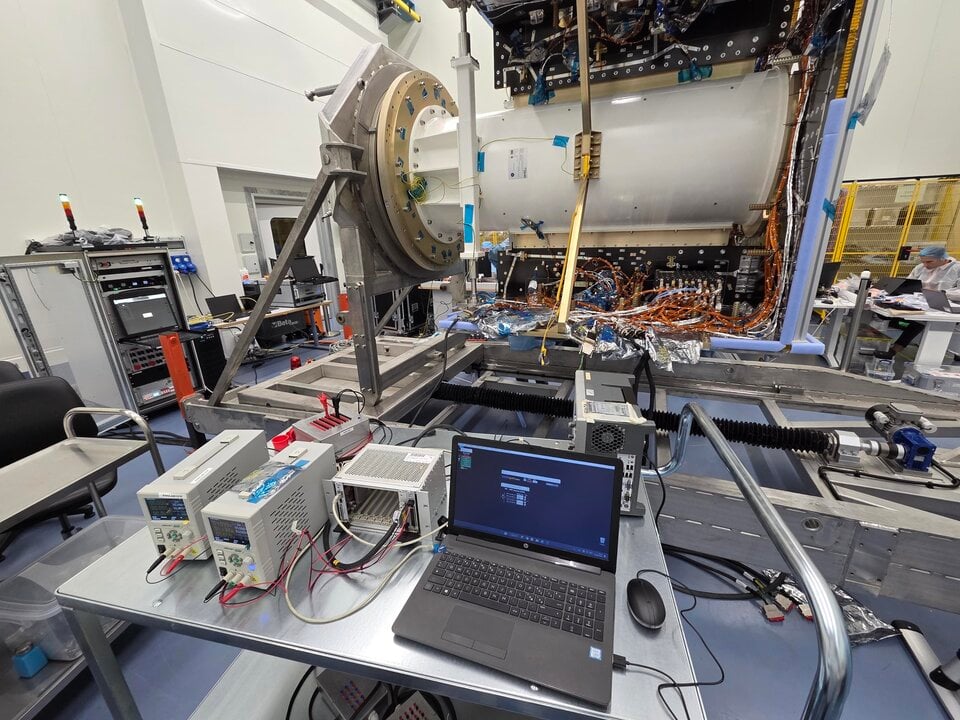
Momentus working on Vigoride-7 in a clean room (Credit: Momentus Inc)
DARPA’s NOM4D mission will utilize the Novel Orbital Moon Manufacturing, Materials and Mass-Efficient Design payload, and will test in-space assembly of modular structures. The spacecraft will demonstrate the reliability and functionality of in-space assembly in Earth orbit. Momentus also manufactured a fuel tank using advanced metal 3D printing from VELO3D. The fuel tank will demonstrate the durability and performance of space hardware using additive manufacturing, significantly decreasing costs from traditional manufacturing methods.
The SpaceX dedicated rideshare program continues to deliver payloads for small satellite companies with over 1,600 satellites launched so far. As the need for cheaper access to space increases, rideshare missions like Transporter will enable more diverse studies and demonstrations at a fraction of the cost of dedicated missions.
(Lead Image: Transporter-15 at SLC-4E before launch. Credit: SpaceX)
The post
SpaceX to deliver 119 payloads to Sun-synchronous orbit on Transporter 16 appeared first on
NASASpaceFlight.com.