Libera
Login
Libera
Login
System Apps
Directory
Help
Language
Random Channel
Report Bug
Search
2026-02-21 16:55:03
View Profile
Information Is Beautiful
via
Chao-c'
infobeautiful@vis.social
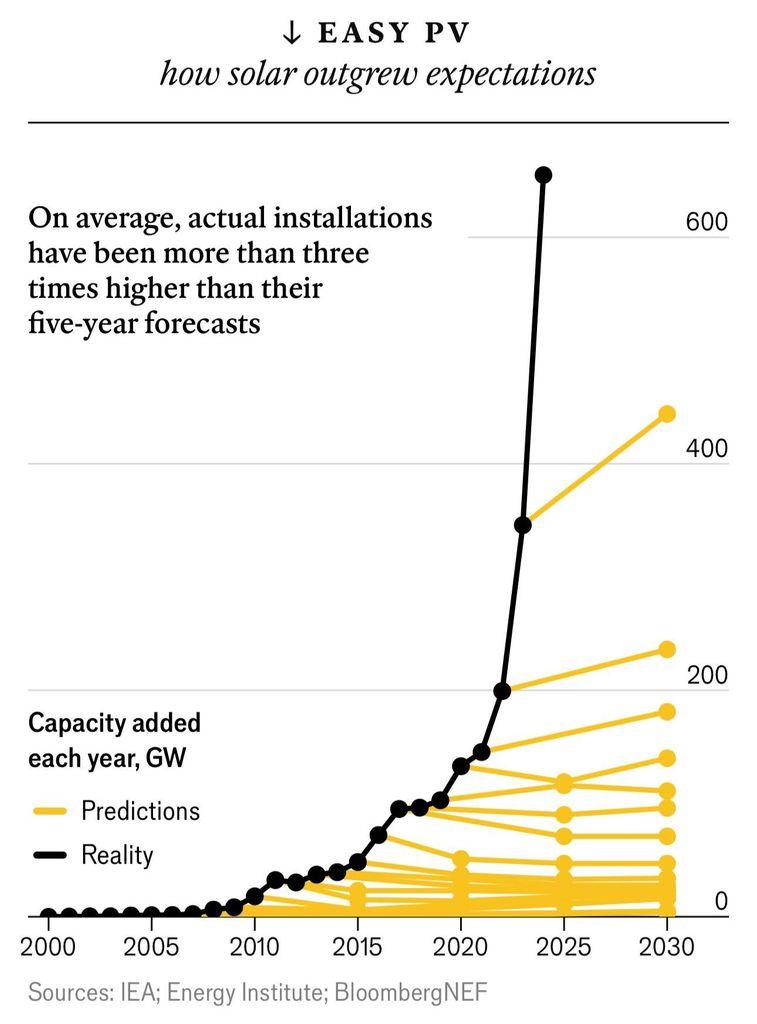
The world’s solar capacity reached 1,419 gigawatts in 2023, way beyond any predictions. 1 gigawatt = power for a medium sized city
A line chart plots global capacity of solar power measured in gigawatts. From 2010 capacity starts to grow exponentially, way beyond a series of predictions drawn as lines in yellow. Actual installations have been more than 3x higher than their five year forecasts.
Link to Source
2026-02-21 17:37:06
View Profile
Nazani
Nazani@universeodon.com
@infobeautiful
What % is residential?
Link to Source
2026-02-21 17:50:10
View Profile
Martin Kostera
martin@libera.site
@
Information Is Beautiful
Power for several hours a day. In winter time even weeks without power, sometimes.
1
1
Link to Source
Expand Replies
2026-02-21 19:27:39
View Profile
Jonathan Hartley
tartley@fosstodon.org
@martin
??? Solar plus wind plus batteries provide power for free, reducing need for fossil fuel dependence by 80% or 100% in some places, what's not to like?
1
Link to Source
Expand Replies
2026-02-21 20:36:15
View Profile
Martin Kostera
martin@libera.site
@
Jonathan Hartley
Nope. You need 100% backup(from about 50% of Ren share). Fossil backup.
That's why it's not cheap. and will not be. Never.
#^
https://en.wikipedia.org/wiki/Dunkelflaute
2
Link to Source
Expand Replies
2026-02-21 21:59:00
View Profile
Jonathan Hartley
tartley@fosstodon.org
@martin
you might need access to 100% backup while still being able to reduce your need for fossil generated energy by a majority amount - those aren't incompatible.
1
Link to Source
Expand Replies
2026-02-22 00:47:38
View Profile
dr2chase
dr2chase@ohai.social
@martin
you seem very certain, as if we could not, say grossly over provision green + batteries, and shut down some industrial processes for the tiny fraction of time when still+dark is too long.
1
Link to Source
Expand Replies
2026-02-22 01:37:11
View Profile
Martin Kostera
martin@libera.site
@
dr2chase
You will never have enough batteries.
Do the math.
Without fossil fuel reserves, it would mean shutting down the country several times a year. Not part of the economy. Not even the entire economy. But the entire country. A total blackout. Worse than what is happening now in Ukraine.
1
Link to Source
Expand Replies
2026-02-22 02:27:08
View Profile
dr2chase
dr2chase@ohai.social
@martin
At the scale of the US, we never get nationwide overcast, nor nationwide lack of wind. We DO need to overprovision both batteries and wind, and distribute that overprovision across the country, and connect it nationwide so that power can be sent from sunny places to overcast places when that occurs.
Putting "Do the math" in bold face is not a proof. If you think it's that obvious, the proof should be easy.
1
Link to Source
Expand Replies
2026-02-22 02:30:01
View Profile
dr2chase
dr2chase@ohai.social
@martin
We an also rearrange our consumption so that loads are curtailed when the weather is unfavorable. Assuming we electrify processes that are currently done with fossil fuel, those will be large loads, and shutting them down for the duration of the worst 1% supply shortages will reduce the energy storage needed -- and only idles the industrial process 1% of the time, not a large loss in production.
1
Link to Source
Expand Replies
2026-02-22 02:39:55
View Profile
dr2chase
dr2chase@ohai.social
@martin
Looking at the wikipedia page: "Events that last more than two days over most of Europe happen about once every five years." And most of them are 24 hours. If the day/night ratio is a cloudless 12:12 and load is Y watts, then solar capacity needs to be 2Y , and battery capacity needs to be 12Ywatt-hours. Away from the equator, say worst is 6:18 then solar needs to be 4Y, and 18Y watt-hours of storage. If, rarely, an entire day's production is missed, then 42Y storage,
1
Link to Source
Expand Replies
2026-02-22 02:43:01
View Profile
dr2chase
dr2chase@ohai.social
@martin
but not much more solar because the 24-hour surplus can be accumulated over several days. Obviously the batteries will cost more, but the larger amount of storage allows gentler charge+discharge and provides more opportunities for load management -- the batteries will have a longer service life.
I'm not seeing a proof of impossibility here, and batteries are still improving.
1
Link to Source
Expand Replies
2026-02-22 03:33:05
View Profile
Martin Kostera
martin@libera.site
@
dr2chase
You have refuted your own statement. Germany is much smaller than the US and has to invest huge amounts of money in backbone lines precisely so that it can transmit electricity from places where the wind blows to places where it does not. These are astronomical costs that are borne by Renew. It will be no different in the US. The laws of physics are the same there.
Like stopping trains? Or refineries? Or a CPU factory? That's not possible. Not even 1% unplanned.
1%? Well, I don't know about the USA, but here in Central Europe we have to reckon with 30 days. That's almost 10%. Several total blackouts a year.
Again, do the math. With real numbers.
The idea from Wiki is naive. There are no backbone lines across Europe that could transmit such surpluses. Perhaps in the distant future, for a few hundred billion euros, such a system could be built. And even then, according to the naive Wiki, it would mean a total blackout once every five years. Even Germany is unable to do so after decades!! And now you ask it for whole EU or USA? No way...
So, for the coming decades, it looks like you need batteries with a capacity of 125 TWh and a peak output of 900 GW for 100% renewable energy and winter outages (1 week). That means batteries worth about $15 trillion. 15T$. Not 15G$. And you have to replace them every 15-20 years or so.
Thanks Thor for France, Finland, Sweden, Slovakia, Bulgaria,...
So I did the math. You are welcome. 😁
1
Link to Source
Expand Replies
2026-02-22 03:41:53
View Profile
dr2chase
dr2chase@ohai.social
@martin
the wikipedia article that YOU put up there said multiday events are very rare, once per 5 years. Not 30 days. The US already has things like the Pacific Intertie, connecting Washington State to southern California on the west coast -- and this was done, for hydropower, so it was already judged to be worth it.
You need to quantify. "Astronomical" is not a number. The things I expect will be electrified in the future include steel, concrete, ammonia, and fresh water production.
1
Link to Source
Expand Replies
2026-02-22 04:13:02
View Profile
Martin Kostera
martin@libera.site
@
dr2chase
over most of Europe
You're not reading very carefully.
So, once again. After decades of building the Renew utopia, Germany still does not have the backbone lines to move surpluses to where there are shortages. Look at the map. And Wiki is talking about the continent. Not Germany. So it will cost decades and hundreds of billions of euros to strengthen/build this backbone network. It doesn't exist. It just isn't there. The current connections between countries can only handle a small part of the surpluses.
And it's not much different in the USA. You will also have to dramatically increase your transmission capacity. Just because you have a wire somewhere doesn't mean that everything will flow through it. 🤷♂️
1
Link to Source
Expand Replies
2026-02-21 20:23:27
View Profile
xs4me2
xs4me2@mastodon.social
@infobeautiful
Soon this will need a log scale…
Link to Source
Conversation Features
Loading...
Loading...
Conversation Features
Loading...
Loading...
Login
Email or nickname
Password
Remember me
Login
Password Reset
Remote Authentication
Register